
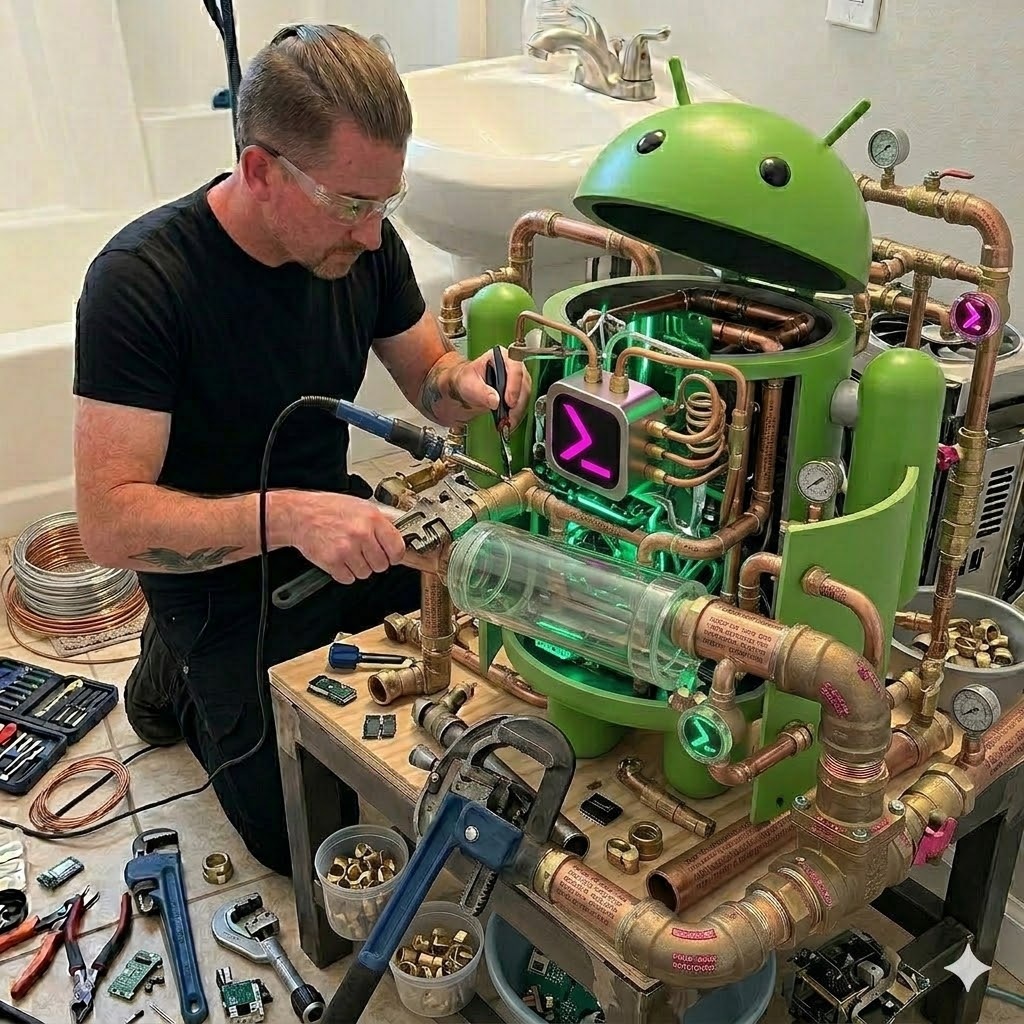
I Fix
The Pipes.
Subsystem runs PowerShell 7.7 in-process inside a native Android app — no Termux, no Linux layer, no chroot, no root. As far as the record shows, that had not been done before. The runspace is one mounted device inside an NT-Object-Manager-shaped CoreCLR runtime: one namespace of refcounted handles, one push transport, no garbage collector on the data plane. Specification and log.
Projects
NT-Shaped Runtime
An in-process CoreCLR / .NET 11 runtime — JIT, full reflection, runtime self-compile via Roslyn — hosting PowerShell 7.7, with the garbage collector removed from the data plane. One object namespace of refcounted handles; per-owner quotas; deterministic cascade-kill. As far as the record shows, the first native in-process CoreCLR + PowerShell runspace on Android: no Termux, no Linux layer, no chroot, no root.
Specification + Log → Source →GPU IPC
Push-model GPU memory transport for Windows. A producer writes a 256-byte-aligned shared texture or buffer exposed through a named NT shared handle, then signals a monotonic timeline fence; consumers wait on the fence value. Zero copies on the same adapter, no polling, no OS scheduler in the hot path. Wait latency is unmeasured; no figure is cited until a benchmark prints one.
DirectPort-SDK →Virtual Camera
A Media Foundation virtual camera over DirectPort. Producer applications run as separate processes and share D3D11 textures with fences through NT handles; a broker multiplexes the feeds into a composited output registered as a system camera. Inter-process frame transfers stay on the GPU.
VirtuaCam →ONNX Without onnxruntime
An ONNX inference engine written in .NET from the protobuf down: the interpreter walks the graph in topological order and dispatches to hand-rolled kernels. It runs Kokoro-82M text-to-speech end to end — 49 of 49 op-types, all 2,463 graph nodes — at RMSE 2.516e-2 against the onnxruntime oracle. It is the substrate under Subsystem's offline TTS and its local LLM path.
Part of Subsystem →Kernel-Fused Source Separation
Meta's HTDemucs 6-stem separator exported as a single ONNX graph — the STFT runs inside the export, so TensorRT fuses the full dataflow. Prior public ports hand-wrote kernels around an externalized STFT; keeping it in the graph makes those kernels unnecessary. Compiled FP16 for a native Windows executable: C# host, C++ bridge, no Python at runtime. 118.7 ms mean GPU compute per 7.8-second chunk on an RTX 3090 (trtexec receipt in-repo).
Demucs_v4_TRT → HuggingFace →TensorRT + Hexagon NPU
RIFE 4.9 frame interpolation compiled two ways. TensorRT for native Windows: Media Foundation hardware decode, C# host, no Python at runtime. And a Qualcomm QNN context binary for the Hexagon V73 NPU (Snapdragon 8 Gen 2) — a model with no prior QNN existence, run on a stock phone without root. Device output is bit-exact against the host reference: max|diff| = 0.000. Pure NPU execute is 81 ms per 256×256 frame, a ~12 fps ceiling; the identified lever is W8A16 quantization. Depth Anything V2 ported to TensorRT the same way.
RIFE_TRT → Depth_TRT →Receipts
| System | Measurement | Mechanism | Receipt |
|---|---|---|---|
| Subsystem gate | 573 standing findings, 0 new permitted | 26 Roslyn analyzers, in-process, fail-closed ratchet | GREEN 2026-07-01 |
| Kokoro-82M on DPX | 49/49 op-types, all 2,463 graph nodes | ONNX interpreter in .NET, no onnxruntime | RMSE 2.516e-2 vs oracle |
| MatMulNBits SIMD | 16-token decode: 88.4 s → 17.1 s | Hand-rolled SIMD q4 kernel | 5.2× |
| Demucs_v4_TRT | Mean GPU compute per chunk, RTX 3090 | Single-graph FP16 engine, fused STFT | 118.7 ms |
| RIFE 4.9 on Hexagon V73 | 81 ms/frame pure NPU execute at 256×256; device vs host reference | QNN context binary, HTP backend, on-device profile | max|diff| = 0.000 |
| VOM cascade-kill | 3 owners → 0, native memory reclaimed | Terminate: token cancel → depth-first handle revoke | Selftest GREEN |
A number appears here only after a benchmark prints it.
Public Service
| CoolPro | An image editor in the browser |
| CoolProMobile | The same editor, shaped for phones |
| MansfieldTeachesTyping | A typing tutor |
| ArlineArcade | Arcade games |
| Emulator | An emulator in the browser |
| art4quinn | Generative remixes |
Free static web apps. No accounts, no ads, no tracking, no backend. They run in the browser and install as PWAs.